Game guide · FYJYSW
An introduction to playing Rummy Sets Practice
Treat this as a chance to practise one rule. Recognise valid three-card or four-card sets using different natural suits. Check the relevant controls before continuing. Use the rule sheet as a reference. Start a 10-question session. Read the visible rule label and wild rank, if shown. Take the next action only when the current step is clear.
500 stored and rule-checked questions; ten questions per session. Questions can repeat across sessions. Practice is solo, with no rating, cash reward or account.
Try a more deliberate round
Treat this as a chance to practise one rule. Natural cards in a set have one rank and different suits; wild cards fill missing positions. Return to the explanation when a decision is unclear.
Your goal
Recognise valid three-card or four-card sets using different natural suits. Use another round to revisit a decision. For a calm first round, focus on one decision.
Making your moves
- Start a 10-question session. Read the visible rule label and wild rank, if shown.
- Natural cards in a set have one rank and different suits; wild cards fill missing positions.
- Study the complete hand before answering. Choose Valid or Not valid.
- Read the explanation after submitting. Each question accepts one submitted answer.
- Continue to the tenth question for a session score; start another session for a new selection.
Using the playing area
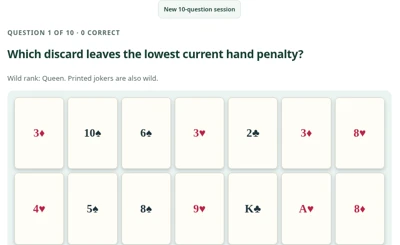
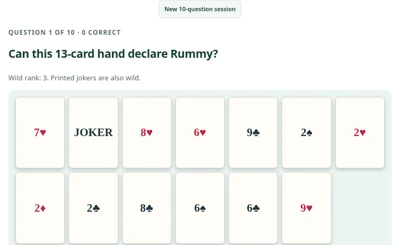
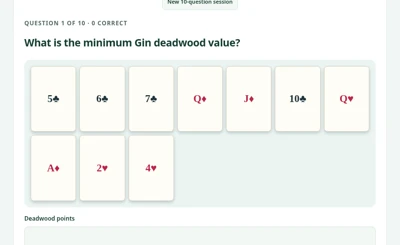
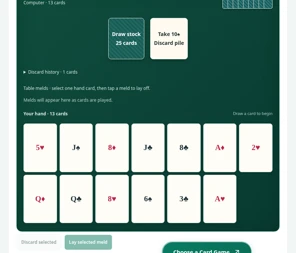
Tap the answer buttons or selected card; the deadwood exercise uses a numeric input. Next question appears after an answer. Take the next action only when the current step is clear. Before making a move, check the cards in view.
A closer look at one example
Example hand: A♠ A♣ A♥ A♠. Wild rank 10. A set needs matching ranks and different natural suits; duplicate natural suits cannot form a set. Use another round to revisit a decision.
A useful caution
Use the rule sheet as a reference. Multiple decks do not make duplicate natural suits valid within one set. Check the relevant controls before continuing.
A few questions answered
What is the aim?
Recognise valid three-card or four-card sets using different natural suits. Look at the complete hand before deciding. Return to the explanation when a decision is unclear.
How do I use the controls?
Tap the answer buttons or selected card; the deadwood exercise uses a numeric input. Next question appears after an answer. Take a moment to read the table. Check the relevant controls before continuing.
Which format is available?
500 stored and rule-checked questions; ten questions per session. Questions can repeat across sessions. Practice is solo, with no rating, cash reward or account. Use the rule sheet as a reference. The same rule applies on a phone and on a computer.
What should I check before a move?
Multiple decks do not make duplicate natural suits valid within one set. Work at your own pace. Return to the explanation when a decision is unclear.
Can you give an example?
Q♠ Q♥ Q♦ is a set. Two natural Q♠ cards and Q♥ are not a valid set. Treat this as a chance to practise one rule. The same rule applies on a phone and on a computer.
How many questions are available?
This exercise contains 500 stored questions. A session selects ten without repeating within that session. Treat this as a chance to practise one rule. The same rule applies on a phone and on a computer.
Can I change a submitted answer?
No. Read the explanation, then continue. Start another session to practise again. Use the rule sheet as a reference. Return to the explanation when a decision is unclear.
Are the answers checked against the rules?
Natural cards in a set have one rank and different suits; wild cards fill missing positions. Keep the active rule in mind. The same rule applies on a phone and on a computer.
Will I always see new cards?
No. The bank is finite, so another session may include a previously played question. Treat this as a chance to practise one rule. The same rule applies on a phone and on a computer.
What does the score measure?
The score is the number of correct answers in this ten-question session. It is not a skill certificate or a prediction of match results. Work at your own pace. Use another round to revisit a decision.